
Lifty Fifty Training Library / Movement reference
Back Squat (Low Bar)
A barbell squat with the bar supported across the rear shoulders. Explore the setup, coordinated hip and knee movement, and the anatomy behind the lift.
- Movement pattern
- Squat
- Movement type
- Compound · Bilateral
- Equipment & setup
- Barbell · Rack
Movement demonstration
Silent videoThe video could not load. Open the video directly or continue with the written reference below.
Movement anatomy
Rendered 3D views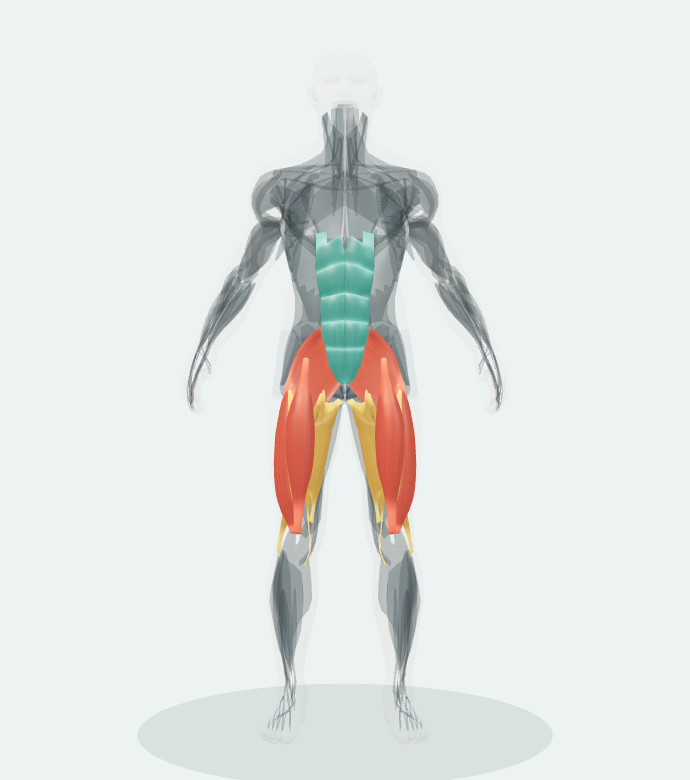
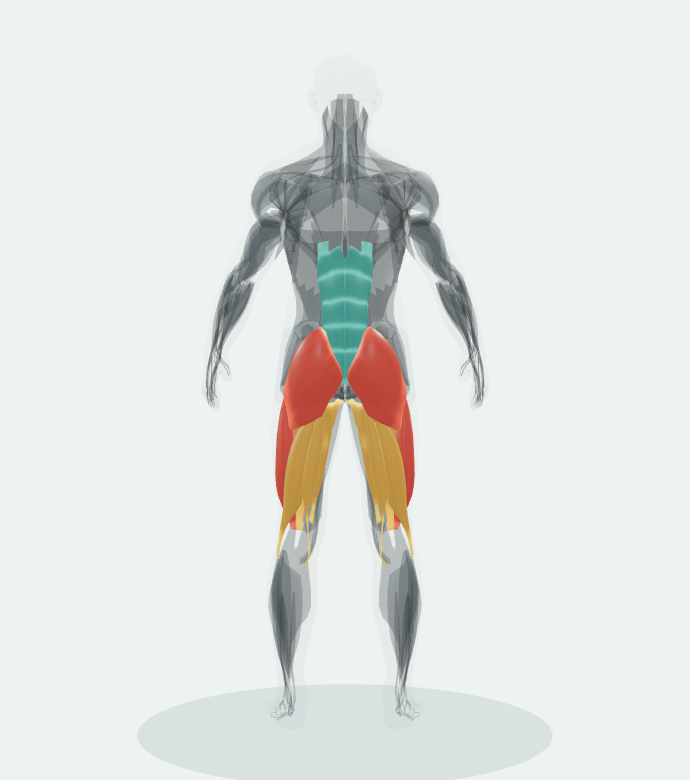
- Primary
- Glutes · Quadriceps Complex
- Secondary
- Hamstrings · Hip Adductors
- Stabilising
- Spinal Extensors · Abdominals · Upper Back
Selected muscles; full roles below. Not measured activation. Read muscle references
Movement profile
Classification and movement demands.
- Category
- Strength Powerlifting
- Movement pattern
- Squat
- Movement family
- Squat
- Movement type
- Compound
- Laterality
- Bilateral
- Plane of movement
- Sagittal
- Body position
- Standing
- Grip
- Pronated
- Technical demand
- Intermediate
- Balance demand
- Low
Setup
Setup requirements.
Set the bar in a rack at upper-chest height. Duck under the bar and position it across the rear deltoids and the spine of the scapula — lower than a high-bar position. Grip the bar with a width that allows the elbows to be pulled up and back behind the bar. Squeeze the shoulder blades together to create a muscular shelf. Unrack by extending the hips and knees, then step back 2-3 steps. Set feet slightly wider than shoulder-width with toes turned out 20-30 degrees.
The low-bar position needs a secure shelf across the rear shoulders and a grip you can maintain. Check rack height and safety supports before loading the bar.
Equipment and optional accessories
Equipment & setup
Barbell · Rack
Equipment group
Free Weight
Optional accessories
Barbell Clips · Lifting Belt · Heel Wedge · Wrist Wraps
Execution
Execution phases.
Descent
Initiate the squat by pushing the hips back and bending the knees simultaneously. The torso will naturally lean forward more than in a high-bar squat — this is correct for the low-bar position. Maintain a braced core and neutral spine throughout. Descend under control (2-3 seconds) until the hip crease passes just below the top of the knee. Weight stays through mid-foot.
Bottom position
Brief pause at depth. Maintain full trunk bracing. Do not relax tension in the glutes, hamstrings, or spinal extensors. The forward lean should not increase at the bottom — if it does, the weight is too far forward.
Ascent
Drive up by pressing through the full foot, leading with the chest. Extend hips and knees simultaneously — hips should not shoot up faster than the shoulders. Maintain the same back angle through the sticking point. Exhale forcefully as you pass the sticking point. Lock out hips and knees at the top.
Breathing and bracing
Take a breath and brace before descending. Maintain the brace through the descent and bottom position, then exhale during the ascent past the sticking point. Reset your breath at the top before the next repetition.
These notes describe this reference example. Follow the movement variation, range, tempo and effort instructions in your own programme.
Coaching
Coaching cues and common errors.
Coaching cues
- Squeeze the bar into your back — create the shelf with your shoulder blades
- Push your hips back first, then bend the knees
- Drive the chest up as you stand — do not let the hips rise without the shoulders
- Spread the floor apart with your feet
- Big breath, brace hard, one rep, rebreathe
Common mistakes to look for
- Bar sliding down the back due to insufficient shoulder blade retraction
- Hips shooting up faster than the shoulders on the ascent (good-morning pattern)
- Excessive forward lean beyond what the bar position demands
- Wrist pain from bearing load through hyperextended wrists instead of the back shelf
- Cutting depth short — the hip crease must pass below the top of the knee for a full rep
Muscle roles
Muscle roles in the movement.
Reference roles describe how muscles contribute to the movement. They do not measure your personal activation or growth.
- Primary muscle groups
- Glutes · Quadriceps Complex
- Secondary muscle groups
- Hamstrings · Hip Adductors
- Stabilising muscle groups
- Spinal Extensors · Abdominals · Upper Back
Scroll across to view all columns
| Muscle | Role | Region |
|---|---|---|
| Gluteus Maximus | Primary | — |
| Rectus Femoris | Primary | — |
| Vastus Lateralis | Primary | — |
| Vastus Medialis Oblique | Secondary | — |
| Vastus Intermedius | Secondary | — |
| Adductor Magnus | Secondary | — |
| Biceps Femoris | Secondary | Long Head |
| Semitendinosus | Secondary | — |
| Iliocostalis | Stabiliser | — |
| Longissimus | Stabiliser | — |
| Lumbar Multifidus | Stabiliser | — |
| Transversus Abdominis | Stabiliser | — |
| Rectus Abdominis | Stabiliser | Upper |
A muscle can have separate entries for different regions or roles.
Open the 3D anatomy referenceJoint context
Joints involved in the movement.
The reference connects this lift to knee, hip, lumbar spine, shoulder, wrist, ankle regions. This adds context to the setup and execution notes.
Reference ratings are authored classifications for this movement. They do not measure your joint loading or predict your individual injury risk.
Scroll across to view all columns
| Joint group | Reference rating | Load mechanisms |
|---|---|---|
| Knee | Moderate | Compression, Shear |
| Hip | Moderate | Compression, End Range |
| Lumbar Spine | Moderate | Axial Loading, Shear |
| Shoulder | Low | Stretch |
| Wrist | Low | Compression |
| Ankle | Low | Compression |
Scroll across to view all columns
| Joint / structure | Reference rating | Load mechanisms |
|---|---|---|
| Knee Joint | Moderate | Compression, Shear |
| Patellofemoral Joint | Moderate | Compression |
| Hip Joint | Moderate | Compression, End Range |
| Intervertebral Disc | Moderate | Axial Loading, Shear, Compression |
| Glenohumeral Joint | Low | Stretch |
| Ankle Joint Talocrural | Low | Compression |
Adults over 50
Over-50s considerations
These are general notes from the movement reference. They do not assess whether this movement is suitable for you.
Possible modifications
- Ensure adequate shoulder external rotation and wrist extension before attempting — the low-bar position demands more mobility than high-bar
- Use a wider grip if shoulder flexibility is limited
- Consider a safety squat bar if shoulder or wrist discomfort prevents comfortable low-bar positioning
- Reduce depth to parallel if hip mobility is restricted
Contraindications noted in the reference
- Severe shoulder impingement or rotator cuff pathology — the externally rotated position under load is provocative
- Acute lumbar disc issues — the increased forward lean places greater shear load on the lumbar spine than high-bar
- Uncontrolled hypertension — heavy barbell squats demand significant breath-holding
Easier variations
- Back squat (high bar)
- Goblet squat
- Box squat
More demanding variations
- Pause squat (low bar)
- Tempo squat (5s eccentric)
- Competition pause squat
Programming
Load, effort and tempo.
Ways to specify intensity
- Percentage of 1RM
- Rating of Perceived Exertion (RPE)
- Repetitions in Reserve (RIR)
- Absolute load (kg)
The programme specifies the load or effort target for each set. These are the intensity formats associated with this movement.
Reference tempo: 3-1-2-0
- Lowering
- 3 seconds
- Bottom pause
- 1 seconds
- Lifting
- 2 seconds
- Top pause
- 0 seconds
Tempo notation lists lowering, bottom pause, lifting and top pause, in that order. This is the library's reference tempo; follow any different tempo specified in the programme.
Read the RIR referenceNames and terminology
Indexed movement names.
The library indexes common names alongside equipment and grip labels. Equipment and grip variants can change the setup and mechanics of the lift.
Scroll across to view all columns
| Name | Name type | Context |
|---|---|---|
| Low Bar Squat | Synonym | General |
| Low Bar Back Squat | Synonym | General |
| Powerlifting Squat | Synonym | General |
| Back Squat (Low Bar) (Olympic Bar) | Attachment | Olympic Bar |
| Back Squat (Low Bar) (Safety Bar) | Attachment | Ssb |
Alternatives
Movement alternatives and substitutions.
Equipment, setup and programme intent can all affect your choice. These examples change aspects of the lift; compare them before substituting.
Goblet Squat
Hold a dumbbell or kettlebell in front of the chest. A different equipment and loading choice.
Back Squat (High Bar)
Move the bar to the upper trapezius. Compare the bar position and setup before changing your squat variation.
Leg Press (45-Degree)
Use a machine to perform the pressing movement with a supported torso. The setup and movement pattern differ from a barbell squat.
All 3 related movements
These are the relationships listed in the movement reference. A regression or progression changes the task; suitability also depends on the load, equipment and programme.
Scroll across to view all columns
| Movement | Relationship | Considerations |
|---|---|---|
| Leg Press (45-Degree) | Alternative | Equipment, Joint Load, Balance |
| Goblet Squat | Regression | Difficulty, Equipment, Skill |
| Back Squat (High Bar) | Variation | Goal |
Your training / Example
Back Squat (Low Bar): training record.
Sample data · 14 Jul–1 Sep 2026
An illustrative record of eight sessions. Every total and estimate below comes from the working sets shown in the history.
- Best estimated 1RM
- 84.6 kg From 72.5 kg × 5
- Heaviest working set
- 72.5 kg 5 repetitions
- Sessions recorded
- 8 24 working sets · 120 reps
- Total volume load
- 7,800 kg-reps · working sets only
Estimated 1RM
Best set estimate per session · kg
A lighter session lowers the set-based estimate; it does not establish a loss of strength.
How this example estimates 1RM
This demonstration uses the Epley formula: load × (1 + repetitions ÷ 30), taking the highest set estimate in each session. It is an approximation based on the recorded load and reps; it does not adjust for the recorded reps in reserve.
These estimates are not tested single-repetition lifts, a training max or an individual prediction. The goal is also an example.
Session history
Expand a session to review every working set and its notes.
1 Sept Strength session 3 × 5 at 72.5 kg 1,087.5 kg-reps 84.6 kg Set detail +
| Set | Load | Reps | RIR | Volume (kg-reps) |
|---|---|---|---|---|
| 1 | 72.5 kg | 5 | 2 | 362.5 |
| 2 | 72.5 kg | 5 | 2 | 362.5 |
| 3 | 72.5 kg | 5 | 1 | 362.5 |
Session note Consistent depth across all three sets. Reviewed the ascent cue before starting.
25 Aug Strength session 3 × 5 at 70 kg 1,050 kg-reps 81.7 kg Set detail +
| Set | Load | Reps | RIR | Volume (kg-reps) |
|---|---|---|---|---|
| 1 | 70 kg | 5 | 2 | 350 |
| 2 | 70 kg | 5 | 2 | 350 |
| 3 | 70 kg | 5 | 1 | 350 |
18 Aug Strength session 3 × 5 at 67.5 kg 1,012.5 kg-reps 78.8 kg Set detail +
| Set | Load | Reps | RIR | Volume (kg-reps) |
|---|---|---|---|---|
| 1 | 67.5 kg | 5 | 2 | 337.5 |
| 2 | 67.5 kg | 5 | 2 | 337.5 |
| 3 | 67.5 kg | 5 | 1 | 337.5 |
11 Aug Lighter session 3 × 5 at 55 kg 825 kg-reps 64.2 kg Set detail +
| Set | Load | Reps | RIR | Volume (kg-reps) |
|---|---|---|---|---|
| 1 | 55 kg | 5 | 4 | 275 |
| 2 | 55 kg | 5 | 4 | 275 |
| 3 | 55 kg | 5 | 4 | 275 |
Session note Planned lighter week. Kept the same range of motion.
4 Aug Strength session 3 × 5 at 67.5 kg 1,012.5 kg-reps 78.8 kg Set detail +
| Set | Load | Reps | RIR | Volume (kg-reps) |
|---|---|---|---|---|
| 1 | 67.5 kg | 5 | 2 | 337.5 |
| 2 | 67.5 kg | 5 | 2 | 337.5 |
| 3 | 67.5 kg | 5 | 1 | 337.5 |
28 Jul Strength session 3 × 5 at 65 kg 975 kg-reps 75.8 kg Set detail +
| Set | Load | Reps | RIR | Volume (kg-reps) |
|---|---|---|---|---|
| 1 | 65 kg | 5 | 2 | 325 |
| 2 | 65 kg | 5 | 2 | 325 |
| 3 | 65 kg | 5 | 1 | 325 |
21 Jul Strength session 3 × 5 at 62.5 kg 937.5 kg-reps 72.9 kg Set detail +
| Set | Load | Reps | RIR | Volume (kg-reps) |
|---|---|---|---|---|
| 1 | 62.5 kg | 5 | 2 | 312.5 |
| 2 | 62.5 kg | 5 | 2 | 312.5 |
| 3 | 62.5 kg | 5 | 1 | 312.5 |
14 Jul Strength session 3 × 5 at 60 kg 900 kg-reps 70 kg Set detail +
| Set | Load | Reps | RIR | Volume (kg-reps) |
|---|---|---|---|---|
| 1 | 60 kg | 5 | 2 | 300 |
| 2 | 60 kg | 5 | 2 | 300 |
| 3 | 60 kg | 5 | 1 | 300 |
Fictional training history for this website preview. These examples illustrate the training-record experience; they are not a programme recommendation or reported member results.